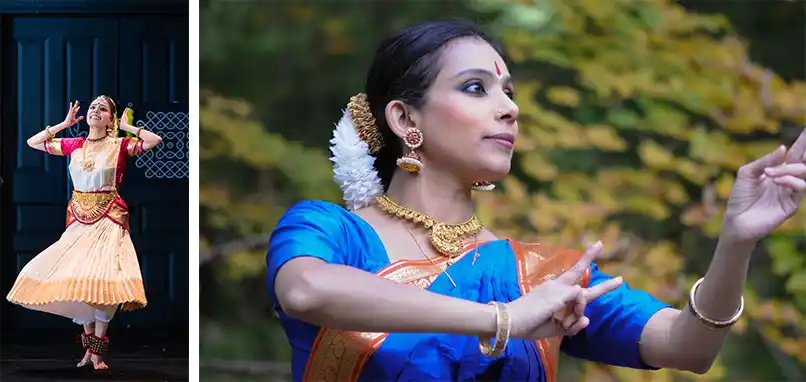
This project would not be possible without the support of Timothy M. Andrews, longtime supporter of the Arts Council of Princeton, who has generously underwritten the Anne Reeves Artist-in-Residence program.
Artist statement about residency:
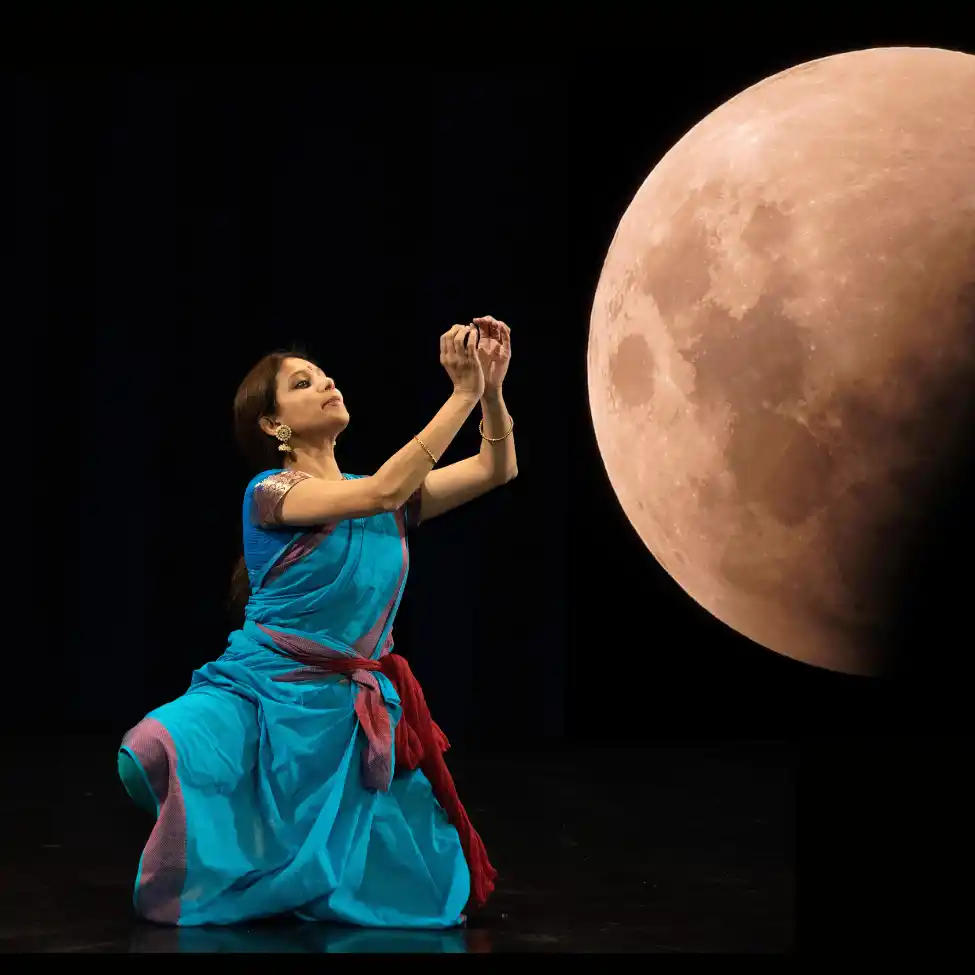
During this residency, I will develop a new choreographic work titled ‘Pratima: Singularity and Beyond.’ This piece uses the intricate vocabulary of Indian Classical Dance to investigate the parallel evolutions of human and artificial intelligence. The choreography will contrast the organic, multi-millennial trajectory of human biological evolution with the exponential growth of synthetic intelligence. I will specifically explore the philosophical threshold of the Singularity—the point at which AI surpasses human capability—and the emergence of Superintelligence. Through Abhinaya (expressive storytelling) and complex rhythmic patterns, I aim to pose a vital question: What does it mean to be human in an era of sentient machines?“
As the community component of my residency, I will host an Interactive Dialogue. I will present a showing of my piece, demonstrating the evolution and possible future of AI.
Following the performance, I will facilitate a guided discussion with the audience. We will explore their perspectives on the future of AI, the concept of the Singularity, and the role of the arts in humanizing technology. This session aims to bridge the gap between ancient tradition and futuristic science, making complex tech-ethics accessible through the beauty of dance.”
Performance and discussion will be held Sunday, March 29. Click here for details.